The Design Principle That Separates Products That Sell From Products That Fail


3 min read
In digital product development, the fastest way to lose money is to build a "functional" solution that nobody uses. The explosion of AI tools has turned this mistake into an epidemic — generating products that launch without a design strategy and, predictably, fail. What gets marketed as "fast" ends up being expensive. The difference between success and failure doesn't come down to the number of features. It comes down to one fundamental principle: Anticipation. This is what separates the platforms users love from the ones they abandon.
Anticipation Isn't a "Design Thing" — It's a Business Strategy
Anticipation directly impacts core business metrics, shifting design from an aesthetic concern to a financial decision. Ignoring this principle has measurable consequences on profitability.
Higher conversion rates — When users find what they need quickly and intuitively, they buy more and abandon flows less.
Lower support costs — A clear, predictable interface eliminates confusion. A user who understands how a product works doesn't need to open a support ticket or call for help.
Operational efficiency — In internal or enterprise products, Anticipation prevents employees from wasting time hunting for information. Those minutes, multiplied across entire teams, represent a direct drain on payroll.
Real competitive advantage — Companies that invest in solid interaction principles outperform competitors who settle for cosmetic UI fixes without solving the underlying problems.
Stronger brand perception — Ease of use builds trust. A product that feels effortless and reliable strengthens brand image — and trust translates directly into sales.
The Most Important Thing Your Users Will Never Tell You
When a digital product fails to anticipate what a person needs, they don't stop to analyze the problem, submit feedback, or file a complaint. They leave. Friction, confusion, and unnecessary cognitive load cause immediate abandonment — especially on public-facing websites and apps, where users aren't captive and have multiple alternatives one click away. The cost of not anticipating is the silent loss of potential customers who will never come back.
"If you make me think, I leave." — Steve Krug
The "We'll Fix It Later" Myth Is an Invisible Money Drain
The "build fast and functional, fix it afterward" strategy isn't a shortcut — it's a guarantee of cost overruns. This mindset creates a vicious cycle of rework that burns through budget, destroys credibility, and produces a product that is expensive, fragile, and unprofitable from the start. The absence of Anticipation from day one generates hidden costs that compound over time: increased support interactions, and revenue lost at every friction point in the user experience.
It's critical to understand that neither artificial intelligence, nor a copied template, nor the most talented engineer can replace the work of an interaction designer. Their role is precisely to anticipate what a user will need at every step — ensuring that a functional product is, above all, a usable and profitable one.
Anticipation in Practice: The Difference Between a Sale and an Abandonment
Two scenarios illustrate the real impact of this principle.
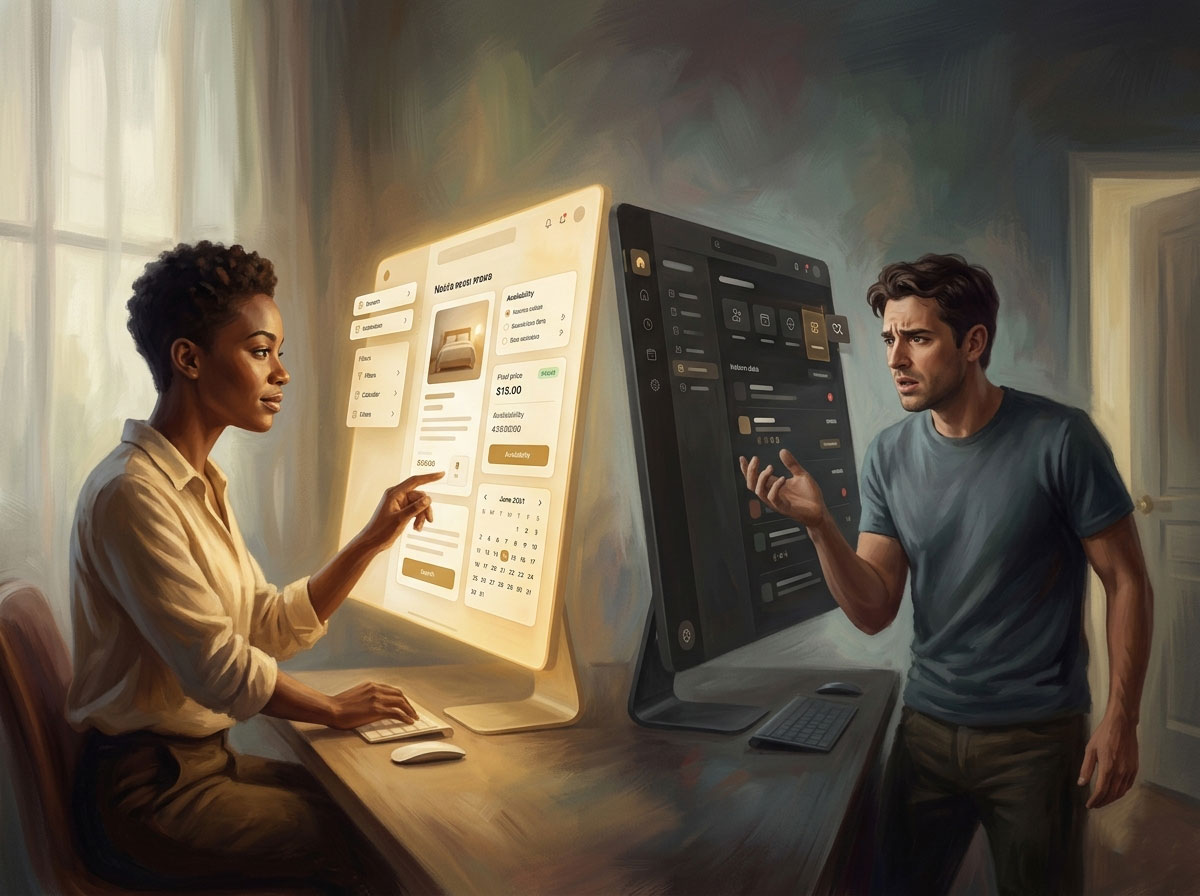
Success Case (with Anticipation): A travel booking platform applies the principle of Anticipation. It surfaces final prices on the first screen, makes availability visible without requiring a click, offers personalized recommendations, and places tools like filters and calendars exactly where users need them.
Results: +37% in conversions, –42% in support tickets, and task completion time cut in half.
Failure Case (without Anticipation): A new financial app forces users into an information hunt — hiding essential data behind multiple screens and ambiguous icons. The system doesn't guide users; it expects them to discover functionality through trial and error, turning a simple query into an exercise in frustration.
Results: 60% of users lost within the first 20 seconds and a 30% increase in complaints. Brand perception shifts to "confusing" and "unreliable".
Conclusion: Design First So You Don't Spend Twice
Anticipation isn't a luxury in product development — it's the strategic investment that protects every other investment. Designing user interaction before writing the first line of code saves time, reduces development and support costs, streamlines internal processes, and directly increases revenue.
The question every stakeholder and product team should be asking is this:
Is your product designed to anticipate what your users need — or is it waiting for them to figure it out on their own?