The Real Cost of Hidden Costs: Why Deceiving Your Customers Is the Worst Business Decision You Can Make


5 minutos
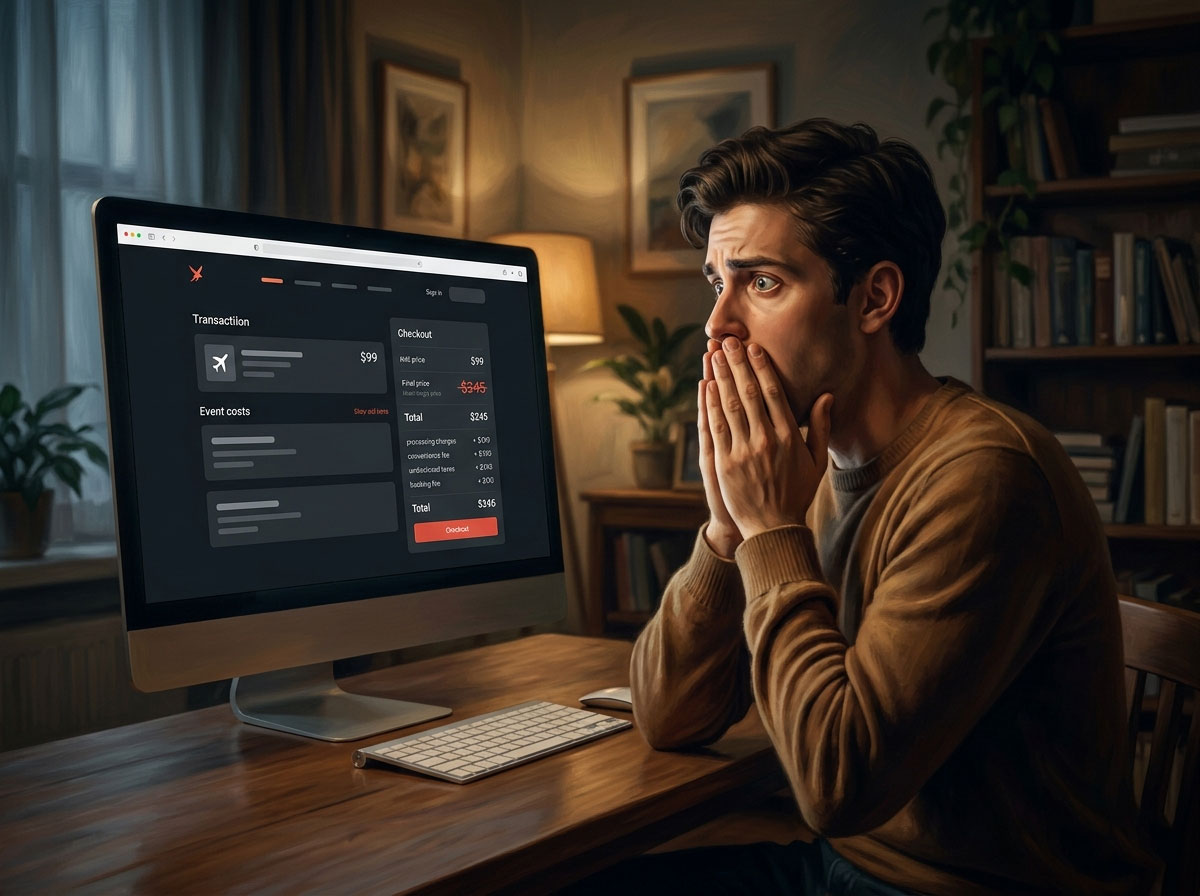
We've all been there. You find a product online at an incredible price — a flight, a hotel, a concert ticket. You invest time selecting the perfect options, fill in your personal details, and just as you're about to enter your credit card number, the final total balloons with a string of "processing fees," "undisclosed taxes," and "service charges" that appear from nowhere. It's a universal frustration — and yet it persists. This isn't a bug. It's a deliberate feature of a broken business strategy.
This tactic, known as hidden costs, is one of the most common and destructive dark patterns in existence. It violates fundamental UX principles and demonstrates a profound disrespect for the customer's time. But why do so many companies keep using it? What is the real impact on their business — and on the trust customers place in their brand?
This article pulls back the curtain on the psychology behind hidden costs. It makes the case for why this strategy is a dead end that cannibalizes future revenue in exchange for illusory short-term gains — and why radical honesty isn't just the ethical choice, it's the most profitable and sustainable business strategy you can adopt.
It's Not a Design Oversight — It's a Psychological Trap
The first thing to understand is that hidden costs are not an interface accident. They are a deliberately engineered trap built on one of the most powerful cognitive biases we have: the sunk cost fallacy.
This bias describes our tendency to follow through on a decision when we've already invested time, effort, or money into it — even when the conditions worsen. In a digital context, the more time you spend filling out forms and selecting options, the deeper your cognitive and emotional investment becomes. Good design reduces friction. This pattern deliberately increases it, creating a psychological pressure that makes it harder to walk away. The system has manipulated you into thinking: "I've come this far — I might as well pay."
The taxi analogy captures it perfectly: a product with hidden costs is like getting into a cab with no meter visible. When you arrive at your destination, the driver invents surcharges for air conditioning and luggage. You might pay that once out of necessity — but you'll never get in that cab again. This tactic exploits your investment and violates two of the most basic principles of good UX: user control and user freedom.
The Short-Term "Win" That Destroys Your Brand Long-Term
Some might argue that if a percentage of users ends up paying, the strategy works. This is a catastrophic miscalculation. Hidden costs are bad business — a textbook example of how a poor user experience translates directly into business failure. The supposed "win" of a forced conversion is eclipsed by the cascading strategic losses it triggers:
Massive drop-off at the final step — Most users aren't fooled. When they feel deceived, they close the tab. This spikes your abandonment rate at checkout — the most critical point in the entire sales funnel.
Destruction of trust — Trust is the most valuable asset a digital brand owns. A single encounter with a deceptive pattern is enough to shatter it completely and permanently.
Zero loyalty and active reputational damage — A customer who feels manipulated won't come back. Worse, they're highly likely to share that experience with friends, family, and social media — actively working against your brand.
Consider the restaurant analogy: you walk in attracted by a €10 menu, but the bill charges you for the cutlery, the tablecloth, and "kitchen management fees." You'll pay because you've already eaten — but would you recommend that place? Would you go back? Not a chance. Good UX ensures the bill matches the original promise, so the customer wants to return tomorrow.
Transparency Isn't Just Ethical — It's Your Strongest Business Strategy
So what's the alternative? Radical transparency. Designing honestly isn't a luxury or an act of pure goodwill — it's an exceptionally smart and sustainable business strategy that builds lasting customer relationships.
Many stakeholders mistakenly view UX/UI design as an aesthetic expense — a coat of paint to make things look nice. The reality is that honest, transparent design is the explicit rejection of that surface-level thinking. It's not decoration. It's a trust-and-revenue-generating machine. It drives conversion through clarity: the customer completes the purchase because they understand and accept the value they're receiving — not because they feel cornered. In a saturated market, honesty becomes your primary differentiator.
The conclusion is simple and powerful:
A user who trusts you comes back.
The Solution Is Simpler Than You Think: Radical Honesty
Avoiding this dark pattern doesn't require revolutionary technology or a massive investment. It requires a firm commitment to honesty and respect for your customers' time and intelligence. The pillars of an ethical — and more profitable — alternative are straightforward:
Show the real final price from the start. The total cost must be visible in the early stages of the process, not an unpleasant surprise at the end.
Break down costs clearly and legibly. Explain what the user is paying for: base price, taxes, fees. Use plain language anyone can understand.
Update the total in real time. When users add or remove options, the final price should adjust instantly and visibly.
Use honest, unambiguous language. Avoid confusing jargon or deliberately vague microcopy to describe each charge. Be direct.
Implementing these practices isn't complicated. Doing so restores the user's sense of control and freedom — the foundations of any great user experience, and the basis of a healthy commercial relationship.
Which Side of Trust Do You Want to Be On?
Hidden costs aren't an interface problem — they're a reflection of a business decision that chooses short-term deception over long-term trust. It's a strategic dead end that actively cannibalizes future revenue in exchange for illusory gains, leaving behind a trail of frustrated customers and a damaged reputation.
In today's digital economy, where alternatives are one click away, trust is the most valuable asset a brand can hold. It takes a long time to build. It takes almost nothing to destroy.
The next time you design a product or make a purchase online, ask yourself: is this experience building trust — or destroying it?